
We have specific thoughts on what this revolution will mean for biology and the life sciences, which we aren’t going to discuss in this post.
Every day, millions of knowledge workers spend hours aggregating data, analyzing information, and making decisions. But imagine if software could not just assist with these tasks, but complete them autonomously, learning from each human interaction to become more effective.
While we haven't yet seen the emergence of a true AI super app, the building blocks are rapidly falling into place.
We're witnessing the dawn of the internet's third wave: the age of intelligent agents.
- Wave one - Aggregation.
- Wave two - Analytics.
- Wave three - Agents.
In an agent world, code will take actions on behalf of humans, reducing the work previously handled by people.
Great founders will understand how to build systems to take action, why those actions matter to their users, and how to capture crucial human - A.I. interaction data within their products to enable a sustainable data moat.
Our friends at Mayfield call these Teammates, my old colleagues at Microsoft call them CoPilots, and others are calling them Companions.
No matter what we call them, the idea is the same - this wave will be all about A.I. doing work for humans.
The Evolution of the Internet
The Evolution of the Internet
Wave One: The Age of Aggregation (1995-2010)
Wave One: The Age of Aggregation (1995-2010)
The internet's first revolutionary wave centered on aggregation - the ability to collect and organize vast amounts of information. Ben Thompson's influential Aggregation Theory explains how this transformation created arguably technology's greatest success story - Google.
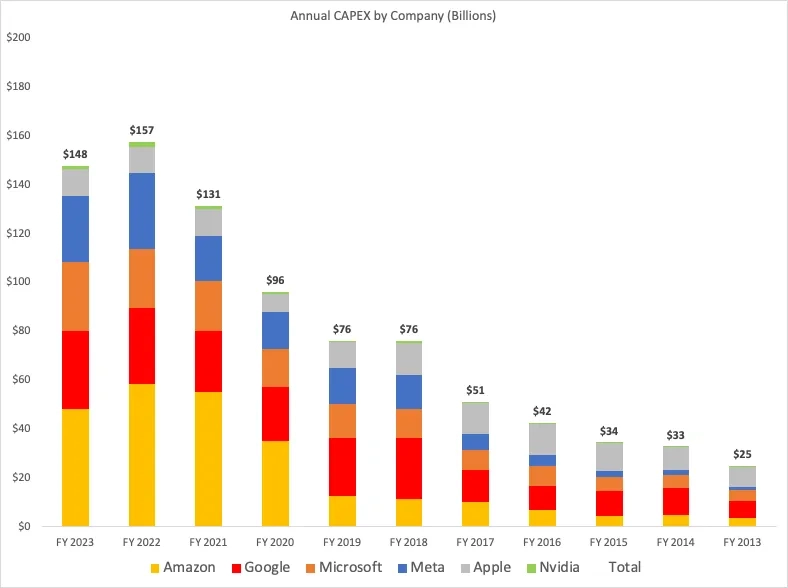
Google’s mission to "organize the world's information" created not just a dominant search engine, but perhaps the most profitable business model in history. This required unprecedented infrastructure investment: over $200 billion in capital expenditures from 2008 to 2023. While this is an enormous number, they have spent $40 billion spent in the last year alone preparing for the third wave. (According to DiscoverCI*)
This investment created a data moat that no one could attack. It created sustainable enterprise value for nearly 30 years.
Wave Two: The Analytics Revolution (2010- Nov 2023)
Wave Two: The Analytics Revolution (2010- Nov 2023)
The second wave brought the rise of analytics through Software as a Service (SaaS) delivered over the internet. Hosting applications on the internet gave legacy software more distribution, and created an opportunity for net new software companies that were not feasible until a SaaS delivery method,
This era saw the emergence of two distinct categories of companies:
- Cloud Platform Giants: Microsoft, AWS, Meta, Google, and NVIDIA achieved trillion-dollar valuations by building the Infrastructure as a Service, Platforms as a Service, and Software as a Service to store and analyze data. Their combined capital expenditure exceeded $871 billion to reach dominant positions in the market.
- Business Solution Providers: Companies like Salesforce, Intuit, ServiceNow, and Workday built multi-billion dollar businesses by creating function or vertical-specific applications that transformed raw data into actionable insights.
💡This wave democratized data access. Non-technical users could finally read from and write to databases through intuitive interfaces.
An entire industry emerged around human-computer interaction and design. But this era's defining characteristic - the need for humans to learn specific software interfaces - has changed.
The capital invested into these applications and the human behavior change to adopt them led to highly profitable and sustainable businesses for over a decade.
Wave Three: The Rise of Agents (Nov 2023+)
Wave Three: The Rise of Agents (Nov 2023+)
The third wave transcends mere data aggregation and analysis. It's about autonomous action. While some firms and companies call these AI teammates, companions, or copilots, we believe their essential characteristic is agency - the ability to act independently on behalf of users.
💡Key Insight: The goal is not to shift human work from one software to another, but to automate human work entirely by transforming them into software processes. This approach frees people to focus on creative and strategic thinking.
Today, you don’t need Google to aggregate data. You can build an application that quickly pulls context-specific data from the web.
You don’t need to sift through data for hours to find insights. A well-constructed natural language query can parse complex, proprietary, and public data in seconds.
Why Agents Matter Now
Why Agents Matter Now
Three key shifts make this transformation possible:
- Commoditization of Internet Data: What once required months and hundreds of thousands in consulting fees to aggregate information can now be accomplished in days. We’ve seen examples of data aggregation problems that required 6 months and $500,000 of consulting work, now being completed by a smart CS graduate student.
- Acceleration of Analysis: Tasks that took weeks now take seconds. Upload a 50-page legal document to an AI, and it can instantly identify key risks and implications.
- Natural Language Interface: Users no longer need to learn specific software interfaces. They can interact with systems using everyday language, dramatically reducing the barrier to adoption. Additionally, those systems can interact with their human counterpart in natural language.
Building the Agent-First Company
Building the Agent-First Company
We talk with A.I. founders every day and they are all extolling their ability to aggregate and analyze data - if everyone is doing it, it is not differentiated.
Six months ago, we estimated one in ten founders talks to us about agents, workflows, and a deep understanding of replacing a customer’s actions and tasks post analytics and insights. The founders who started building in this space 6-9 months ago, and are staying close to their customers, are coming to the realization that data aggregation and analytics are no longer sufficient to separate them from competition. We now are seeing this ratio go up to three out of ten. We expect it to go up more as these company building frameworks become more mainstream.
Software companies are realizing that when the aggregation and analytics are commoditized, you have to move to higher order activities to not only capture more economic value, but to remain relevant to the customer.
Success in this new era requires four essential elements:
- Deep Customer Understanding: Intimate knowledge of user workflows, pain points, and objectives.
- Natural User Experience: Meeting users where they are, rather than forcing them to learn new systems.
- Built-in Feedback Loops: Continuous learning from user interactions through reinforcement learning from human feedback (RLHF).
- Personal Adaptation: Systems that customize themselves to individual users, creating unique experiences at scale.
The New Moat: Human-AI Interaction Data
The New Moat: Human-AI Interaction Data
While data was once considered the new oil, we're seeing companies overcome traditional data limitations through synthetic data, innovative architectures, and improved models. Our belief is that the real, sustainable competitive advantage now lies in human-AI interaction data:
- User feedback on AI responses
- Workflow modifications and corrections in the product
- Personal preferences and patterns defined by the user or recorded by the product over time
- Task completion strategies
This creates a compound effect: the more users interact with the system, the more personalized and effective it becomes, creating an increasingly valuable and difficult-to-replicate advantage.
Venture Market Outlook
Venture Market Outlook
We're entering a period of both unprecedented opportunity and risk. Companies are achieving million-dollar revenue run rates faster than we have ever seen, while burning less capital.
Simultaneously, we will overbuild artificial intelligence applications and infrastructure. We are seeing too many funding rounds for data aggregators, analytics focused A.I. platforms, and GPT wrappers, with most tackling the same obvious customer problems... They will not all survive.
As Mark Twain said - “History doesn’t always repeat itself, but it often rhymes”. There is yet to be a period in modern technology history (starting in the mid-1700s) that has defied Carlota Perez’s boom and bust life cycle as described in her seminal Technological Revolutions and Financial Capital.
Carlota Perez’s framework still holds true here - the degree of diffusion is going up, cash is flowing in, and the value created and capital invested have not balanced to a healthy ratio yet. We are still in the irruption phase (see below) as brilliant entrepreneurs are ~one year into applying these foundation models to nearly every industry and aspect of our lives. Money will flow in, a bubble will form, and many companies and investors will lose money and time.
💡Many, if not most, companies built in A.I. over the next 10 years will not be protectable, which means the value they create will be accessible at the lowest possible costs. We will enter another era of value surplus that the previous waves both provided.
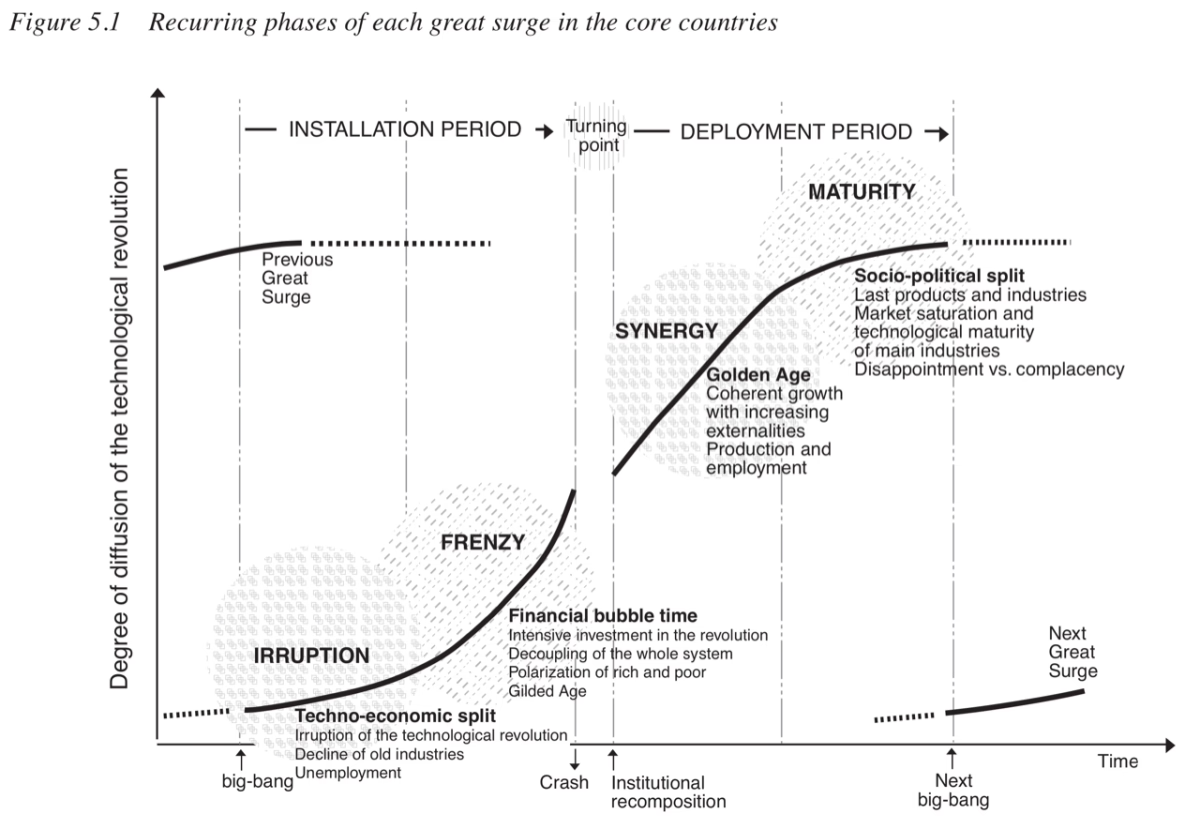
In summary, following historical patterns described in Carlota Perez's "Technological Revolutions and Financial Capital," we expect:
- Overinvestment in basic capabilities (data aggregation, analysis)
- A shake-out of undifferentiated solutions, with the corresponding financial loss to VCs and others
- Eventual consolidation around companies that truly reduce human work through effective agency
The Path Forward
The Path Forward
For entrepreneurs and investors, the key differentiator will be focusing on genuine agency rather than mere analysis. The winners won't be those who help humans work with data more efficiently, but those who eliminate the need for routine human intervention entirely.
The most successful companies will:
- Build deep understanding of specific workflows
- Create truly autonomous capabilities
- Generate compound advantages through interaction data acquisition
- Build systems that create a constant, high quality feedback loop into the product
- Focus on reducing human work rather than transferring it
The age of intelligent agents is just beginning, but its impact will likely dwarf the previous waves of internet revolution.
Artificial General/Super Intelligence
Artificial General/Super Intelligence
We have avoided discussing AGI/ASI in this piece because honestly there are too many opinions and not enough knowledge about what will happen when we reach this state. We are techno optimists, so we tend to believe Terminator is not right around the corner, but in all of our discussions, readings and research, we aren’t in a position to have any idea on what will happen to the world if we reach some type of singularity.
What Do You Want To Hear Next?
What Do You Want To Hear Next?
We are going to continue to publish research, data and our ideas on this space - but we want to hear from you all in the comments what is most interesting for us to share next:
1. Challenges of Implementing Agentive AI
2. Regulation and Governance
3. Human-AI Collaboration
4. Differentiation of AI Agents
5. Economic Impact
6. Pathways to Adoption
Footnotes
- Capex Data Source: DiscoverCI Capital Expenditure Analysis, 2023
- Carlota Perez's seminal work: Technological Revolutions and Financial Capital